Insert Molding EOATs
Custom end of arm tooling that loads inserts and unloads finished parts in one robot cycle, with accuracy up to 0.001".
Inserts loaded in the robot cycle
Molds need inserts to be in exactly the right place before they close. An insert molding EOAT picks up staged inserts, pulls the finished parts, places new inserts in the mold, and drops the parts on the conveyor, all in one robot cycle.
True North designs and builds insert molding EOATs around your part, your inserts, and your mold, along with the equipment that stages the inserts for the robot. We have several ways of aligning the tool to the mold and the staging equipment, and we choose the one that suits your mold and tolerances.
Insert molding is detailed work, and it’s work we like. Every job starts with a design meeting with one of our engineers.
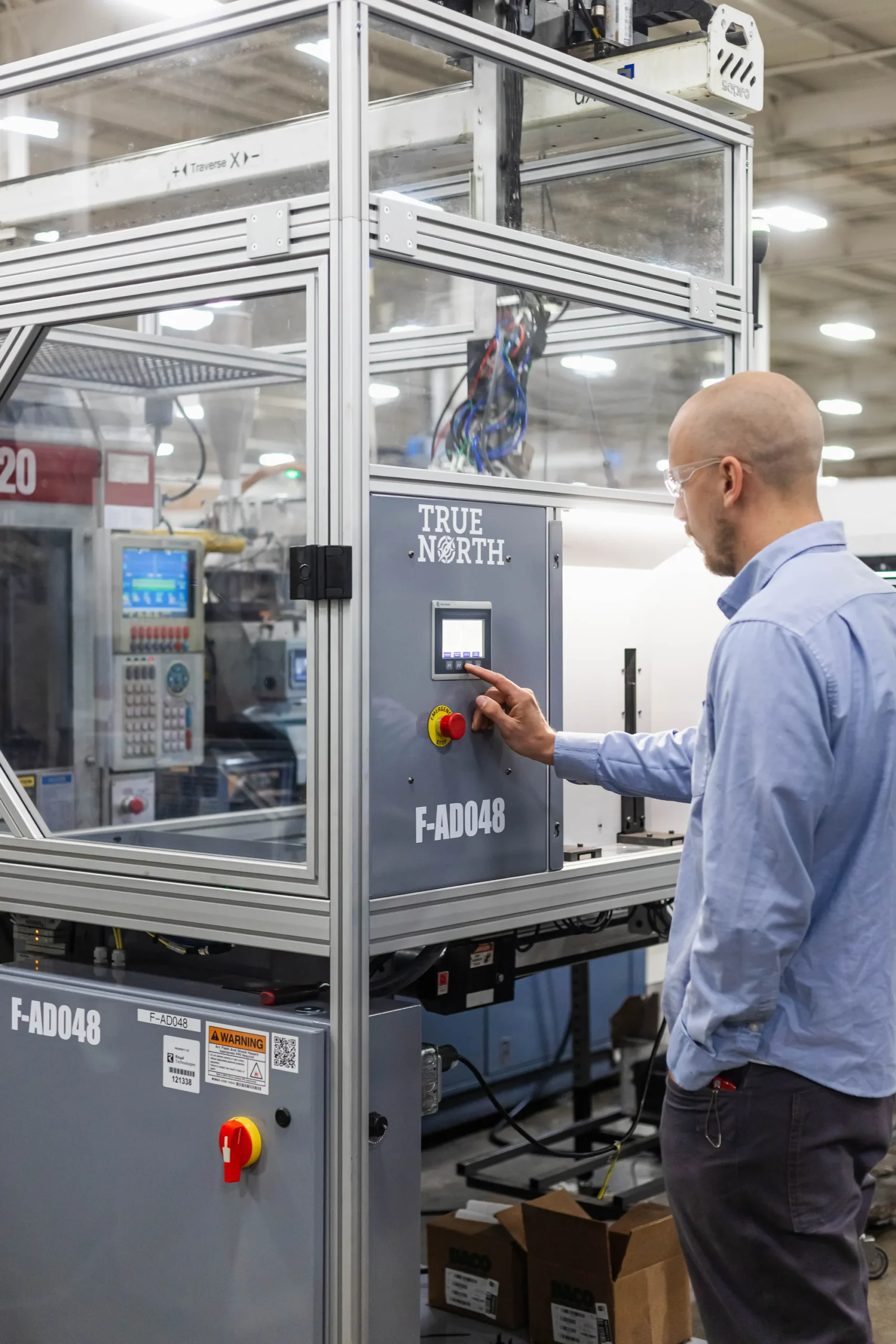 Insert staging fixture
Multiple ways to stage inserts
The right setup depends on your part geometry, your budget, and your volume. We’ll recommend one when we quote.
Staging fixtures can dock to the press. They wheel away for cleaning or storage, swap with another fixture for a different part, or move to another mold. When they dock back in, they return to the same aligned position. Fixtures can also be mold-mounted, floor-mounted, or pinned to the concrete.
Past Insert Job Examples
A sample of the inserts our EOATs and staging equipment have loaded.
- Brass threaded inserts
- Steel stampings
- Impact spacers
- Other plastic parts
- Zinc castings
- Clear lenses
- Z-clips
- Compression limiters
- Knurled pins
- Steel bar stiffeners
- And more
 Robot-mounted EOAT
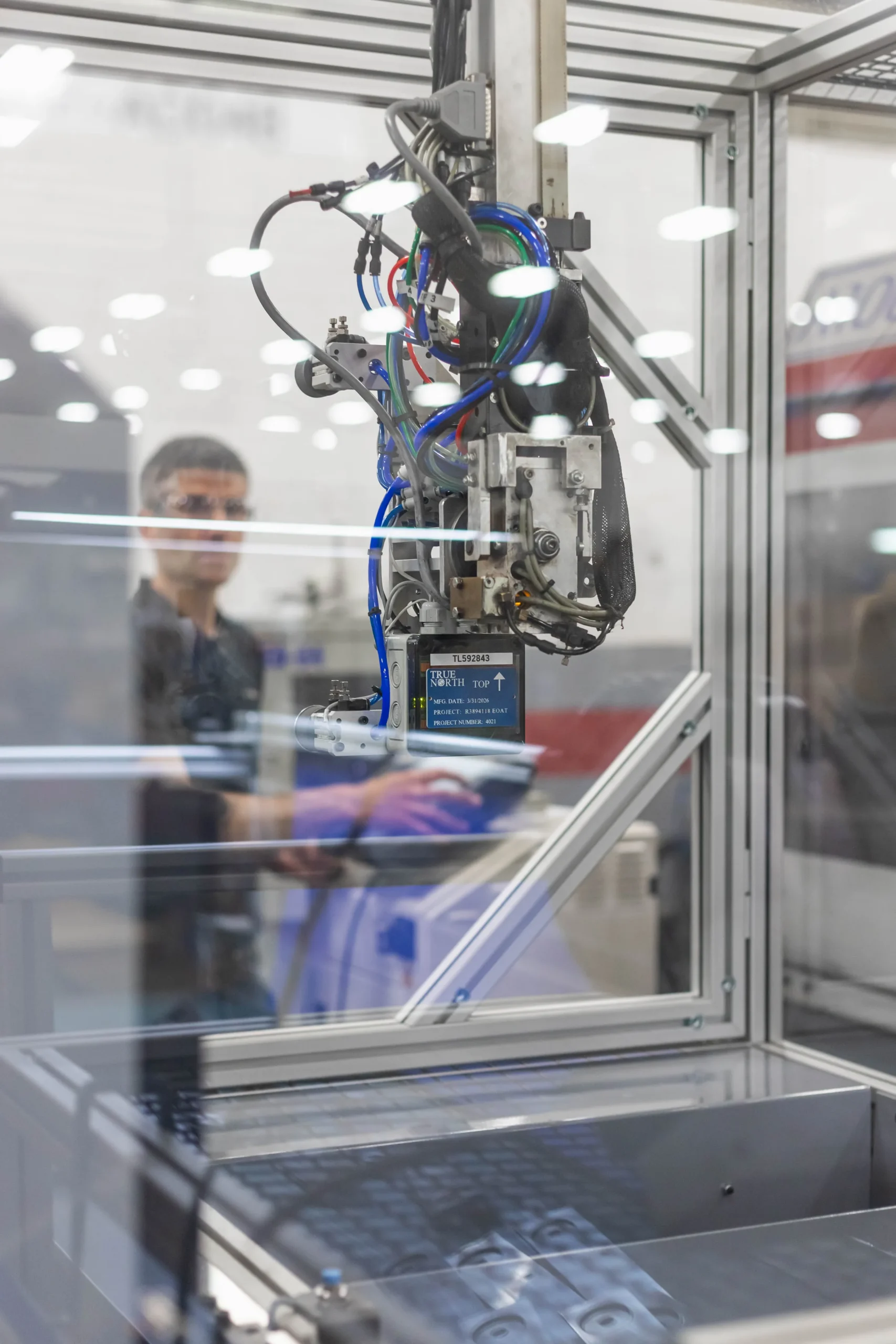 EOAT in a molding cell
Insert molding automation across industries
Our insert molding EOATs and staging equipment run on automotive lighting and lens assemblies, automotive interior and seating parts, appliance components, electrical components, medical devices, office furniture, and agricultural equipment parts, mostly for injection molders across Michigan and the Midwest.
Insert molding questions, answered
What does an insert molding EOAT do?
It loads fresh inserts into the mold and removes the finished parts in the same robot cycle, so the mold closes on new inserts every shot.
How are inserts presented to the robot?
It depends on your part geometry, budget and volume. Inserts can be staged by an operator in a fixture, queued on an accumulation conveyor, carried in nests on a conveyor, or oriented by a bowl feeder and staged by a SCARA or 6-axis robot.
How accurately can inserts be placed in the mold?
We have several ways of aligning the EOAT to the mold and to the staging equipment, chosen to suit your mold and your tolerances. Inserts can be placed with accuracy up to 0.001".
What kinds of inserts can you load?
Threaded brass, knurled pins, steel stampings and stiffeners, compression limiters, zinc castings, lenses, clips, other plastic parts, and more. If it can be gripped and located, we can usually design a way to load it.
Do you build the insert staging equipment too?
Yes. We design and build the staging fixtures, conveyors, and bowl feeder cells along with the EOAT, so the whole system is designed together and aligned to the same mold.
Can you add insert loading to an existing cell or mold?
Yes. Send us the mold or part files, the inserts, and your current setup, and we’ll tell you what it takes to automate the loading.
What do you need to quote an insert molding EOAT?
Part and mold CAD, insert drawings or samples, your volume and cycle time, and your robot and press details. Our EOAT quote form takes your files directly.
Have inserts to load?