Degating EOATs, built to cut your gates at the press
Custom end of arm tooling, degate plates and press-side fixtures that cut gates and runners off injection molded parts automatically — a clean, consistent vestige every cycle, with no one trimming at the press.
Degating built into the robot cycle
When parts come off the press with the gate still attached, someone has to cut it. Hand trimming adds a step between the press and the box and leaves vestige that changes from part to part and shift to shift. A degating EOAT cuts the parts for you during the robot cycle, with parts coming from the known mold position.
True North designs and builds degating EOATs around your part, your gates and your press. The robot pulls the part, the nippers cut the gate to vestige, the runner goes to the scrap bin and the finished part lands on the conveyor. When the gate location, the number of gates or the size of the gates means the cut can’t be made on the tool, we degate off the tool instead, with a degate plate mounted to a beam or the floor, or a dedicated press-side degate fixture. When the part’s finish calls for it, urethane nests hold the part for the cut.
Every nipper is sized for your gate and your material. Hard plastics like PC and ABS, glass-filled grades and clear lenses all cut differently, so we check the material before we pick the nipper. Our lab oven lets us test-cut small parts warm, and on particularly tricky parts, heated blades keep cracks from spreading into the part. Our standard lead time is 3–4 weeks, with a 1-week expedite when a press is waiting, and every tool ships with its full design and replacement-part files.
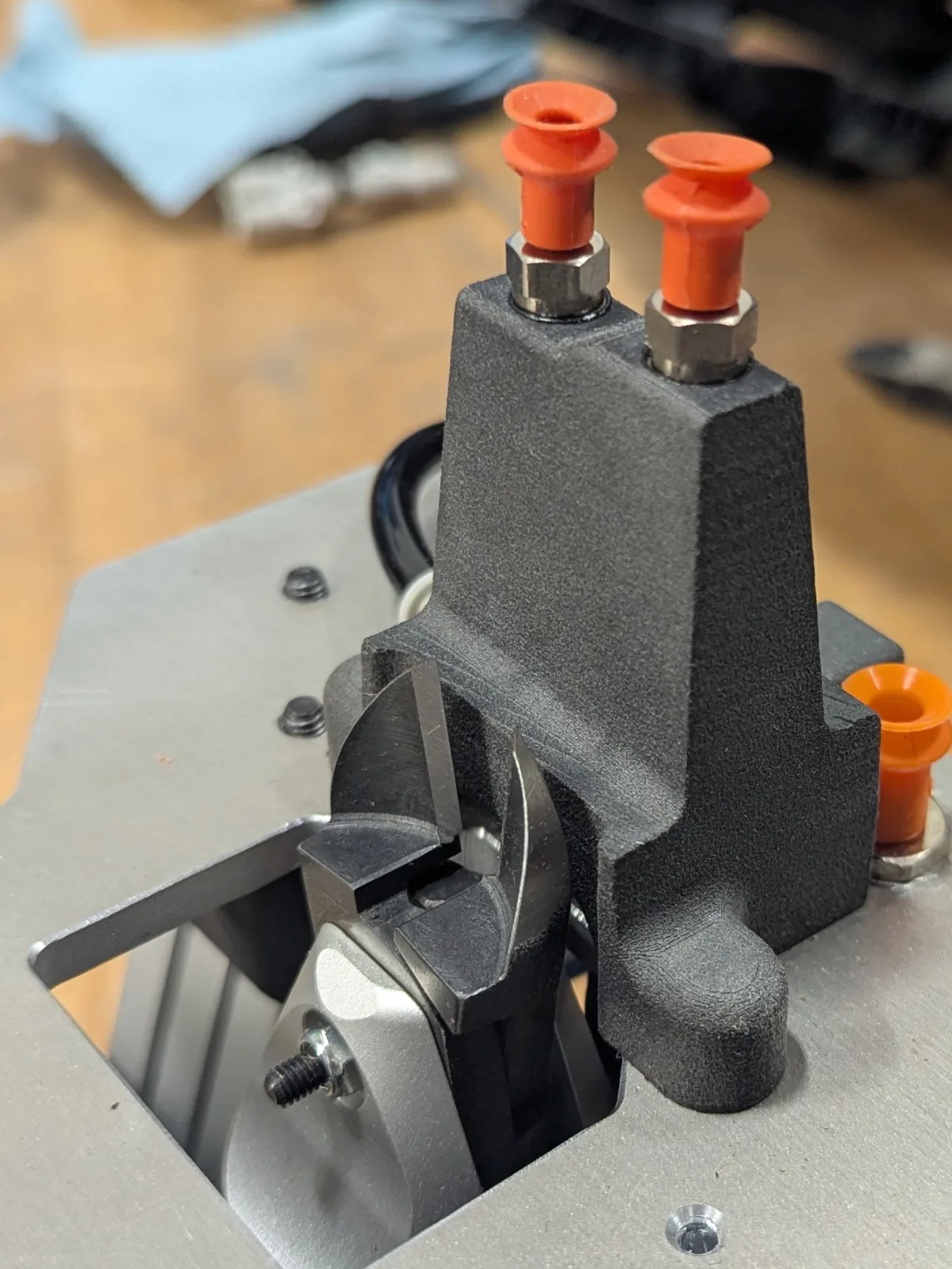 Degating nest on an EOAT
Why degate on the EOAT instead of a degate plate or valve gates?
Cutting the gate on the robot tool, in the same cycle that pulls the part, saves money and steps compared with a separate degate fixture, hand trimming or a mold conversion.
When the cut belongs off the tool
Some gates sit where the robot tool can’t reach them, or there are too many of them, or they’re too big to cut on the tool. For those, we degate off the tool with a degate plate mounted to a beam or the floor, or a dedicated press-side degate fixture. The robot sets the part into a nest, the gates are cut, and the finished part moves on while the next shot molds — all inside the cell’s guarding.
- Gate locations the robot tool can’t reach
- Many gates on one part
- Large fan gates and film gates
- Thick or heavy runners that need more cutting force
- Tight vestige or cosmetic A-surfaces
- Cells where the robot needs to get back to the mold fast
Degating at the press
Every degate is different. These are the ones we’re asked for most.
- Degating EOATs that cut on the robot
- Degate plates and press-side degate fixtures
- Edge gate and runner cutting to vestige
- Sprue picking and runner removal to scrap
- Degating for multi-cavity and family molds
- Lenses and cosmetic parts that must not crack or mark
- Hard, filled and engineering plastics
- Degating added to an existing EOAT or cell
- Part orientation and presentation for the cut
- Spare blades and wear parts
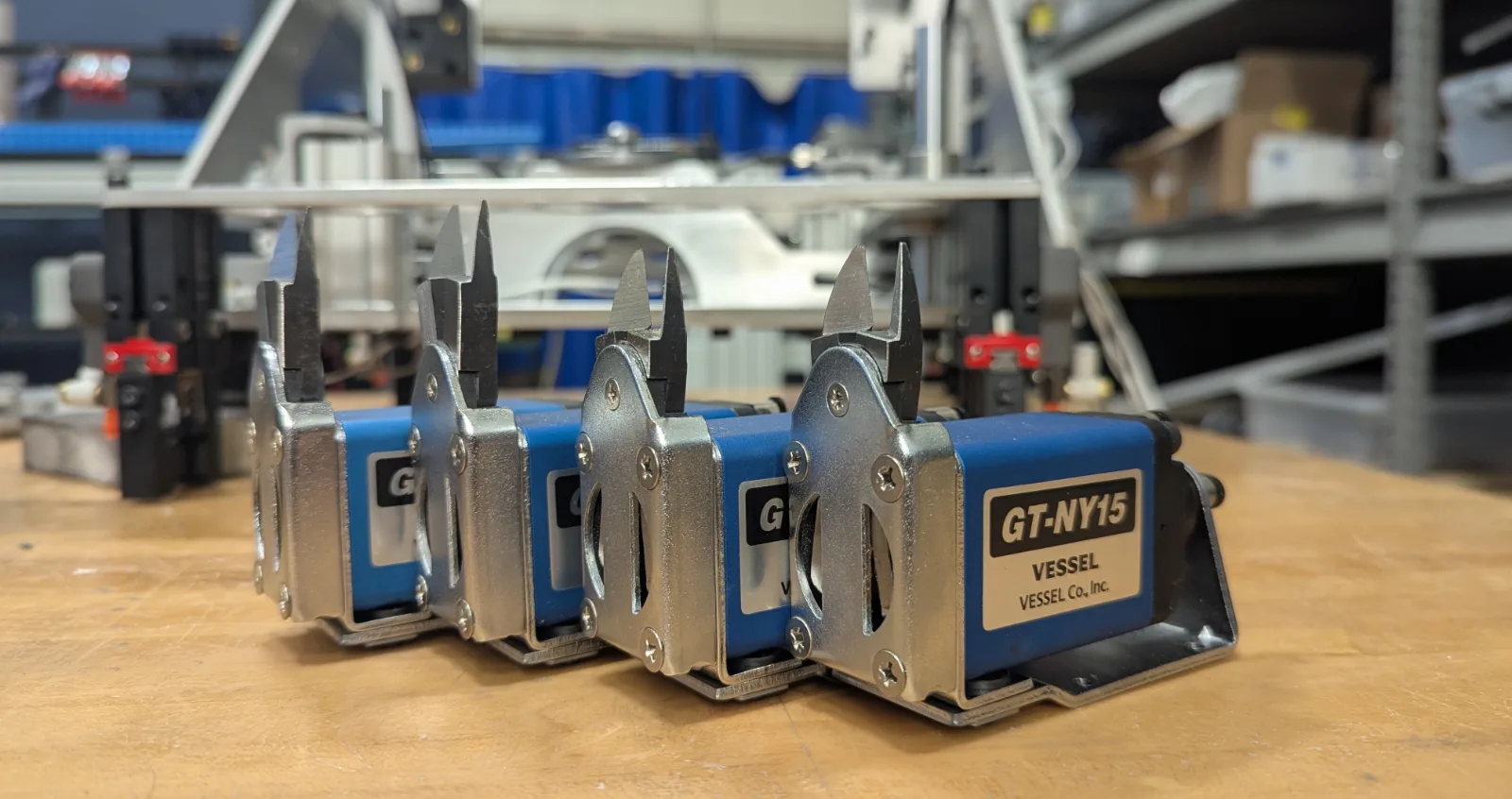 Air nippers ready for a degating tool
 Degate EOAT for mold tending
Degating across industries
Our degating tools run on automotive lighting lenses and side markers, exterior trim and graphic plates, interior parts, medical device components and consumer products — from single-cavity molds to multi-cavity and family tools, mostly for injection molders across Michigan and the Midwest.
Degating questions, answered
Is degating on the EOAT cheaper than a degate plate or valve gates?
Usually, yes. Degating on the EOAT uses the tool you already need, so there’s no separate degate plate, fixture or guarding to buy, and it costs far less than converting a mold to valve gates or a hot runner. We’ll tell you honestly when a part is better served another way.
Should degating happen on the EOAT or off the tool?
It depends on your part and your gates. Cutting on the tool saves floor space and handles the gate while the robot carries the part away. Off the tool, a degate plate mounted to a beam or the floor, or a dedicated press-side degate fixture, holds the part in a nest for the cut while the next shot molds. That suits gates the tool can’t reach, many gates, large fan gates or heavier cuts. We’ll recommend one when we quote.
Can you add degating to an EOAT we already run?
Yes. We regularly add degate nippers to existing tools, and degate plates or fixtures to existing cells. Send us the tool or its files along with the part, and we’ll tell you what it takes.
What do you need to quote a degating tool?
Part or mold CAD, the gate locations, your vestige requirement, the part material, and your robot and press details. Our EOAT quote form asks for all of it and takes your files directly.
Does the part material matter for degating?
Yes, a lot. Hard plastics like PC, ABS and PC/ABS need more cutting force than PP or PE, glass-filled materials wear blades faster, and clear or brittle parts such as lenses can crack at the cut. We size every nipper for your material, and if the material isn’t known yet, we design for the harder case and tell you so in the quote.
How clean will the gate vestige be?
We design every cut to your vestige spec. Because the part is held exactly as it came off the mold, the cut lands in the same place shot after shot, with no operator-to-operator variation.
How fast can you build a degating EOAT?
Our standard lead time is 3–4 weeks. When a press is waiting, a 1-week expedite is available.
What about spare blades and wear parts?
Cutting blades are standard replacement parts, and every tool ships with its full design and replacement-part files, so you can stock spares or make your own instead of waiting on us.
Have a gate to cut?